Showing posts with label cruz medina pochoteca. Show all posts

Wednesday, March 2, 2011

Macroparasitism and Microparasitism in Mesoamerica The Aztec

The Humbleness and Forced Humility of the Pochteca

The pochecas were not allowed to flaunt their success for fear of being put to death by jealous nobility. This is worth taking into consideration.

I'm not sure of the author of this pdf strangely enough:

"The pochteca grew to be quite wealthy, but they were restricted in terms of the “flaunting” of their wealth and how much they couldaccumulate. First, they did not want to inflame the jealousy of the ruler. Many a merchant was put to death by a noble who desired the merchant’s fortune - an experience not uncommon among European Jews"(24).


http://www.uri.edu/artsci/ecn/starkey/ECN398%20-Ecology,%20Economy,%20Society/aztec2006.pdf

Rodolfo F. Acuña's "The Making of the Political Pocho"

Pocho as Socially Comfortable Middle-Class
A function of this blog is to document the different definitions, connotations and embodied rhetoric that 'pocho' takes on. It should be noted that many of the people in the 'list' section have 'owned' pocho, reclaiming it as a self-identification. Acuña's article http://www.aztlan.net/pocho.htm seems to denote 'pocho' in the vein Gloria Anzaldua uses when she describes it as 'cultural traitor.'

From Acuña's article:
"I make the analogy of the pocho because when many of us entered the public schools we spoke fluent Spanish. In fact, it was our only language. Because of the lack of maintenance of Spanish our development in the language remained at a primary school level. It did not advance to reading Spanish language literature. English in many cases became our primary language. Meanwhile, we were not able to take Spanish classes until high school when we repeated like parrots, "?HOLA PACO, QUE TAL? ?COMO ESTAS?
Many former Chicano activists through a lack of political maintenance have become political pochos. They learned the basics of Chicano studies, its language, but have not advanced beyond a cultural level. They identify with the culture, but not the political dimensions of culture. Over time, they begin to think about the barrio as a justification for their entitlements. Notions such as the transformation of the barrio become alien to their political vocabulary"

It is true that Acuña is calling into question the political commitment of middle class Latin@s and Chican@s; however, I am interested in the use of 'pocho' and how it is deployed to denote transgression.
Update: 
No, I have no real great insights that I have come to about the perceived transgressions of pochismo at this time; rather, I tracked down the Chuck Norris image that kept coming to mind every time I looked at the "El Pocho" movie poster above so I had to add it for visual juxtaposition purposes.

Tuesday, March 1, 2011

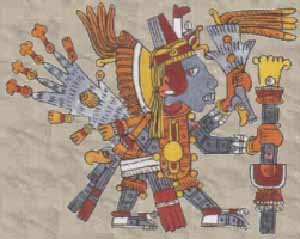
Pochteca Deity Yacatecuhtli

From: Aztec Mythology: The Influence of Aztec Mythology on Mexican Culture and History
By: James W. Salterio Torres


Description of the Yacatecuhtli:
"Yacatecuhtli, like the Greek Hermes, is the god of merchants, traders and travelers. He is pictured with white and black facial decorations, his hair is bound in a high sheaf, and he carries a staff and a flywhisk. He is honored by having his statues wrapped in paper wherever they are found. Merchants hold their walking stick, a massive cane called an utlatl in high esteem. They carry these walking sticks when traveling and when they arrive at a place they are to sleep, they gather all of their sticks in one bundle and tie them together, lay them at the head where they are to sleep and spill drops of blood in front of them from their tongue, ears or arms and legs; they offer copal and light a fire that burns before the walking sticks which they hold as the image of the god himself. This is their way of asking for the god’s protection from all dangers. (Restored by the author from the Codex Fejervany Mayer)"


I'm not sure how the deity of the pochteca affects the embodied rhetoric of the pochteca as a figure. Although Dolores Delgado Bernal has looked at the role of spirituality in the academic identity of Latin@ students, so this could be an aspect to consider.

Sunday, February 27, 2011

Que Dice Wikipedia sobre 'Pocho'

Pocho According to Wikipedia

Wikipedia is the first website that comes up when googling, so I might as well post what comes up when discussing Pocho in the public discourse.
Here is how the Wikipedia description begins:
"Pocho (pocha fem.) is a term used by native-born Mexicans to describe Chicanos who are perceived to have forgotten or rejected their Mexican heritage to some degree. Typically, pochos speak English and lack fluency in Spanish. Among some pochos, the term has been embraced to express pride in having both a Mexican and an American heritage[1] asserting their place in the diverse American culture. The word derives from the Spanish word pocho, used to describe fruit that has become rotten or discolored."
http://en.wikipedia.org/wiki/Pocho

What is noteworthy is the distinction that is made between the fluidity of the connotation. In some parts, Tijuana por ejemplo, pocho does not carry a negative meaning, serving only as a descriptive distinction from less Anglo/American-influenced persons of Mexican heritage.
(Interesting 'Pocho art' from the website: http://www.agencianotaalpie.org)