Decolonial Imaginary for the potential of future
In Nahuas After the Conquest, James Lockhart makes mention of female merchants in the squares where the pochteca traded. Still, Lockhart makes the point that there were no hints, besides these pictures of women in the market, that women were of the pochteca class of merchant. For my work, this is not helpful because the "@" symbolizes the inclusivity of gender that the "a/o" binary previously noted.
However, I am not daunted by reading this because I rely on Emma Perez's notion of the decolonial imaginary that reconstructs historical narrative for their potential, instead of uncritically going along with colonized historical narratives. I could only speculate whether Lockhart had any agenda with regard to dismissing the potential of women as pochteca, but I would add that it's the many Chicanas with whom I've worked with and studied under who have inspired me with their networks and negotiation of ideologies that I do not face because of male privilege that I have done nothing to earn and benefit from, many times when I am unaware.
After all, if we don't disconnect the pocho from deficiency rhetoric, what will be left with?
Showing posts with label cruz medina pocho rhetoric. Show all posts
Tuesday, March 8, 2011
Thursday, March 3, 2011
Pocho as Spanglish & Bruised Fruit
A Note on "Pochismo" Author(s): William E. Wilson
Kicking it old school, here is an excerpt from a 1946 article that speaks of pocho as a Spanglish kind of dialect.
From The Modern Language Journal, Vol. 30, No. 6, (Oct., 1946), pp. 345-346
"POCHISMO, derived from pocho, an adjective which originally meant discolored, has now come to mean a type of popular slang in Mexico. In the evergrowing list of pocho expressions are many hybrid words, artificial combinations of English and Spanish. Indicative of its spread is the inclusion of many words of this type in a Spanish vocabulary list prepared for U. S. Border Patrol Trainees.' with the remark that "those words underlined are colloquialisms but are often used on the Mexican border and the officer will get better results if he understands them." Typical examples in this list are bebi, baby; yaque, jack; diche, ditch; lonche, lunch;pene, pen (penitentiary); esteche, stage; traque, track, and huachar, to watch. Mexican intellectuals and conservatives have long endeavored to check the spread of this hybrid language, and even held an Anti-Pochismo week in August, 1944."
(Sun Mad Ester Hernandez)
This image kind of goes along with the theme of the bruised fruit or even dead on the vine as it were.
Kicking it old school, here is an excerpt from a 1946 article that speaks of pocho as a Spanglish kind of dialect.
From The Modern Language Journal, Vol. 30, No. 6, (Oct., 1946), pp. 345-346
"POCHISMO, derived from pocho, an adjective which originally meant discolored, has now come to mean a type of popular slang in Mexico. In the evergrowing list of pocho expressions are many hybrid words, artificial combinations of English and Spanish. Indicative of its spread is the inclusion of many words of this type in a Spanish vocabulary list prepared for U. S. Border Patrol Trainees.' with the remark that "those words underlined are colloquialisms but are often used on the Mexican border and the officer will get better results if he understands them." Typical examples in this list are bebi, baby; yaque, jack; diche, ditch; lonche, lunch;pene, pen (penitentiary); esteche, stage; traque, track, and huachar, to watch. Mexican intellectuals and conservatives have long endeavored to check the spread of this hybrid language, and even held an Anti-Pochismo week in August, 1944."
(Sun Mad Ester Hernandez)
This image kind of goes along with the theme of the bruised fruit or even dead on the vine as it were.
Wednesday, March 2, 2011
Rodolfo F. Acuña's "The Making of the Political Pocho"
Pocho as Socially Comfortable Middle-Class
A function of this blog is to document the different definitions, connotations and embodied rhetoric that 'pocho' takes on. It should be noted that many of the people in the 'list' section have 'owned' pocho, reclaiming it as a self-identification. Acuña's article http://www.aztlan.net/pocho.htm seems to denote 'pocho' in the vein Gloria Anzaldua uses when she describes it as 'cultural traitor.'
From Acuña's article:
"I make the analogy of the pocho because when many of us entered the public schools we spoke fluent Spanish. In fact, it was our only language. Because of the lack of maintenance of Spanish our development in the language remained at a primary school level. It did not advance to reading Spanish language literature. English in many cases became our primary language. Meanwhile, we were not able to take Spanish classes until high school when we repeated like parrots, "?HOLA PACO, QUE TAL? ?COMO ESTAS?
Many former Chicano activists through a lack of political maintenance have become political pochos. They learned the basics of Chicano studies, its language, but have not advanced beyond a cultural level. They identify with the culture, but not the political dimensions of culture. Over time, they begin to think about the barrio as a justification for their entitlements. Notions such as the transformation of the barrio become alien to their political vocabulary"
It is true that Acuña is calling into question the political commitment of middle class Latin@s and Chican@s; however, I am interested in the use of 'pocho' and how it is deployed to denote transgression.
Update:
No, I have no real great insights that I have come to about the perceived transgressions of pochismo at this time; rather, I tracked down the Chuck Norris image that kept coming to mind every time I looked at the "El Pocho" movie poster above so I had to add it for visual juxtaposition purposes.
A function of this blog is to document the different definitions, connotations and embodied rhetoric that 'pocho' takes on. It should be noted that many of the people in the 'list' section have 'owned' pocho, reclaiming it as a self-identification. Acuña's article http://www.aztlan.net/pocho.htm seems to denote 'pocho' in the vein Gloria Anzaldua uses when she describes it as 'cultural traitor.'
From Acuña's article:
"I make the analogy of the pocho because when many of us entered the public schools we spoke fluent Spanish. In fact, it was our only language. Because of the lack of maintenance of Spanish our development in the language remained at a primary school level. It did not advance to reading Spanish language literature. English in many cases became our primary language. Meanwhile, we were not able to take Spanish classes until high school when we repeated like parrots, "?HOLA PACO, QUE TAL? ?COMO ESTAS?
Many former Chicano activists through a lack of political maintenance have become political pochos. They learned the basics of Chicano studies, its language, but have not advanced beyond a cultural level. They identify with the culture, but not the political dimensions of culture. Over time, they begin to think about the barrio as a justification for their entitlements. Notions such as the transformation of the barrio become alien to their political vocabulary"
It is true that Acuña is calling into question the political commitment of middle class Latin@s and Chican@s; however, I am interested in the use of 'pocho' and how it is deployed to denote transgression.
Update:
No, I have no real great insights that I have come to about the perceived transgressions of pochismo at this time; rather, I tracked down the Chuck Norris image that kept coming to mind every time I looked at the "El Pocho" movie poster above so I had to add it for visual juxtaposition purposes.
Tuesday, March 1, 2011
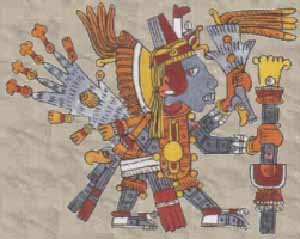
Pochteca Deity Yacatecuhtli
From: Aztec Mythology: The Influence of Aztec Mythology on Mexican Culture and History

Description of the Yacatecuhtli:
"Yacatecuhtli, like the Greek Hermes, is the god of merchants, traders and travelers. He is pictured with white and black facial decorations, his hair is bound in a high sheaf, and he carries a staff and a flywhisk. He is honored by having his statues wrapped in paper wherever they are found. Merchants hold their walking stick, a massive cane called an utlatl in high esteem. They carry these walking sticks when traveling and when they arrive at a place they are to sleep, they gather all of their sticks in one bundle and tie them together, lay them at the head where they are to sleep and spill drops of blood in front of them from their tongue, ears or arms and legs; they offer copal and light a fire that burns before the walking sticks which they hold as the image of the god himself. This is their way of asking for the god’s protection from all dangers. (Restored by the author from the Codex Fejervany Mayer)"

I'm not sure how the deity of the pochteca affects the embodied rhetoric of the pochteca as a figure. Although Dolores Delgado Bernal has looked at the role of spirituality in the academic identity of Latin@ students, so this could be an aspect to consider.
By: James W. Salterio Torres
Description of the Yacatecuhtli:
"Yacatecuhtli, like the Greek Hermes, is the god of merchants, traders and travelers. He is pictured with white and black facial decorations, his hair is bound in a high sheaf, and he carries a staff and a flywhisk. He is honored by having his statues wrapped in paper wherever they are found. Merchants hold their walking stick, a massive cane called an utlatl in high esteem. They carry these walking sticks when traveling and when they arrive at a place they are to sleep, they gather all of their sticks in one bundle and tie them together, lay them at the head where they are to sleep and spill drops of blood in front of them from their tongue, ears or arms and legs; they offer copal and light a fire that burns before the walking sticks which they hold as the image of the god himself. This is their way of asking for the god’s protection from all dangers. (Restored by the author from the Codex Fejervany Mayer)"
I'm not sure how the deity of the pochteca affects the embodied rhetoric of the pochteca as a figure. Although Dolores Delgado Bernal has looked at the role of spirituality in the academic identity of Latin@ students, so this could be an aspect to consider.
Labels:
cruz medina,
cruz medina pocho rhetoric,
cruz medina pochoteca,
cruz medina pochteca,
pochoteca,
pochteca,
yacatecuhtli
Monday, February 28, 2011
Pocho by José Antonio Villarreal
O.G. Pochismo
Villareal's 1959 novel Pocho has been lauded as one of the first Chican@ novels. It's a coming of age tale about a young Mexican American, Juan Manuel Rubio, who reconciles his place in the U.S. as neither relating exactly with his father's Mexico-born generation, nor Anglo society at large.
Freudian fans might try to break it down as a bildungsroman with all kinds of id, ego, superego at play, but as a borderlands theorist, I see much more generative potential in acknowledging differential consciousness at at work a la Chela Sandoval.
The above image comes from the cover of the book, but has been re-appropriated as a project of a decolonial imaginary.
Villareal's 1959 novel Pocho has been lauded as one of the first Chican@ novels. It's a coming of age tale about a young Mexican American, Juan Manuel Rubio, who reconciles his place in the U.S. as neither relating exactly with his father's Mexico-born generation, nor Anglo society at large.
Freudian fans might try to break it down as a bildungsroman with all kinds of id, ego, superego at play, but as a borderlands theorist, I see much more generative potential in acknowledging differential consciousness at at work a la Chela Sandoval.
The above image comes from the cover of the book, but has been re-appropriated as a project of a decolonial imaginary.
Sunday, February 27, 2011
Que Dice Wikipedia sobre 'Pocho'
Pocho According to Wikipedia
Wikipedia is the first website that comes up when googling, so I might as well post what comes up when discussing Pocho in the public discourse.
Here is how the Wikipedia description begins:
"Pocho (pocha fem.) is a term used by native-born Mexicans to describe Chicanos who are perceived to have forgotten or rejected their Mexican heritage to some degree. Typically, pochos speak English and lack fluency in Spanish. Among some pochos, the term has been embraced to express pride in having both a Mexican and an American heritage[1] asserting their place in the diverse American culture. The word derives from the Spanish word pocho, used to describe fruit that has become rotten or discolored."
http://en.wikipedia.org/wiki/Pocho
What is noteworthy is the distinction that is made between the fluidity of the connotation. In some parts, Tijuana por ejemplo, pocho does not carry a negative meaning, serving only as a descriptive distinction from less Anglo/American-influenced persons of Mexican heritage.
(Interesting 'Pocho art' from the website: http://www.agencianotaalpie.org)
Wikipedia is the first website that comes up when googling, so I might as well post what comes up when discussing Pocho in the public discourse.
Here is how the Wikipedia description begins:
"Pocho (pocha fem.) is a term used by native-born Mexicans to describe Chicanos who are perceived to have forgotten or rejected their Mexican heritage to some degree. Typically, pochos speak English and lack fluency in Spanish. Among some pochos, the term has been embraced to express pride in having both a Mexican and an American heritage[1] asserting their place in the diverse American culture. The word derives from the Spanish word pocho, used to describe fruit that has become rotten or discolored."
http://en.wikipedia.org/wiki/Pocho
What is noteworthy is the distinction that is made between the fluidity of the connotation. In some parts, Tijuana por ejemplo, pocho does not carry a negative meaning, serving only as a descriptive distinction from less Anglo/American-influenced persons of Mexican heritage.
(Interesting 'Pocho art' from the website: http://www.agencianotaalpie.org)
Subscribe to:
Posts (Atom)